

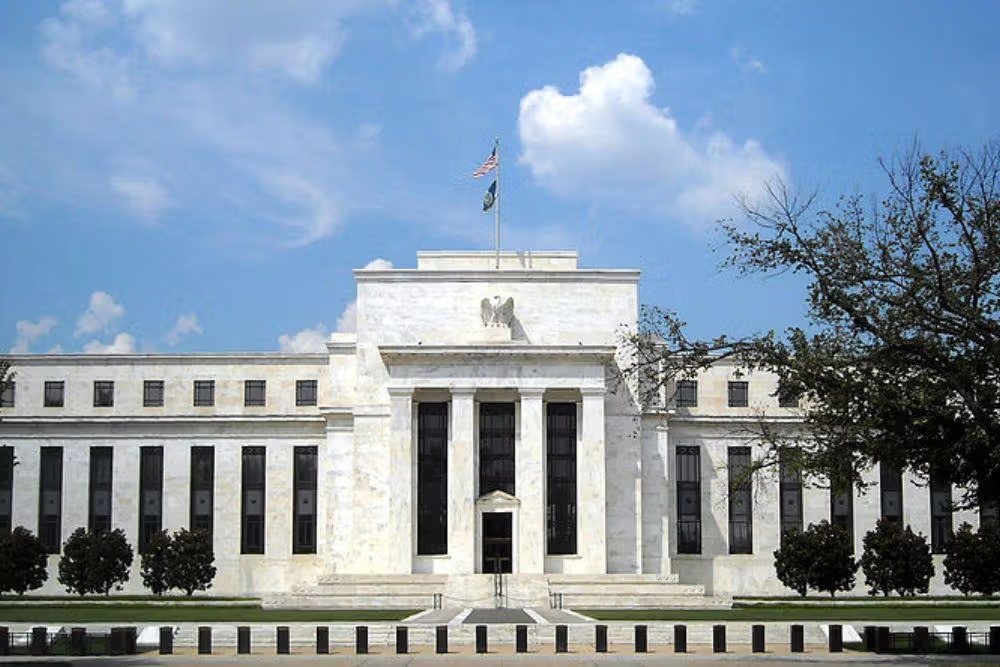
Washington D.C. – The United States Federal Reserve has once again opted to keep its key interest rate unchanged, maintaining it at approximately 4.3% for the fourth consecutive time. This decision comes despite a bleaker economic forecast from policymakers, who now anticipate slower growth, higher unemployment, and faster inflation than previously predicted.
Typically, the Fed adjusts borrowing costs to stimulate or cool the economy. However, facing an unusual confluence of factors, including the potential impact of new tariffs, the central bank is holding firm.
Federal Reserve Chairman Jerome Powell acknowledged the challenging environment, noting that while the economy remains “solid” and unemployment low at 4.2%, the bank is braced for prices to rise more quickly. This expected surge is largely attributed to businesses passing on the costs of new import taxes to consumers.
“That process is very hard to predict,” Powell stated, emphasizing that the size and duration of these tariffs will dictate their full effect. “That is why we think the appropriate thing to do is hold where we are.”
Economic Projections Take a Hit
The Fed’s latest projections paint a less optimistic picture for the economy. Growth is now expected to slow to 1.4% this year, a significant drop from 2.5% last year and the 1.7% forecasted in March. Inflation is projected to be around 3%, up from 2.7% in March, and the unemployment rate is expected to tick up to 4.5%.
Despite these revisions, the outlook for interest rate cuts in 2025 remains largely unchanged, with a majority of policymakers still expecting rates to dip just below 4% by year-end. However, projections for 2026 and 2027 anticipate slightly higher rates than previously thought.
Trump’s Criticism and Central Bank Independence
The Fed’s decision has drawn renewed criticism from President Donald Trump, who has repeatedly urged the central bank to cut interest rates. Ahead of Wednesday’s announcement, Trump publicly lambasted Powell, calling him “stupid” and “too late” to act.
However, Fed officials are empowered to set interest rates independently of the White House. They have voiced concerns that a one-time price jump caused by the new levies could escalate into a more persistent inflation problem, which currently sits at 2.4% in May, still above the Fed’s 2% target.
Isaac Stell, an investment manager at Wealth Club, suggested that Trump’s strong opinions might inadvertently reinforce the Fed’s resolve. “Central bankers tend to jealously guard their independence, which means that unless there’s a really compelling reason to cut they might just stay sat on the fence,” Stell observed.
Global Context and Impact on Borrowing Costs
While the US central bank holds steady, other major central banks are moving. The European Central Bank has cut interest rates eight times since last June, and the Bank of England also lowered borrowing costs last month.
The Federal Reserve’s benchmark interest rate directly influences what it charges banks for short-term loans. This, in turn, significantly impacts borrowing costs across the entire economy, affecting everything from mortgages to business loans for households and businesses. At 4.3%, the current rate remains considerably higher than the period between 2008 and 2022 but is about a percentage point lower than last year’s peak.
US Central Bank Holds Rates Steady Amid Worsening Economic Outlook and Tariff Concerns